
HPLC/UHPLC Technical Tip
Level: Intermediate
Scaling Analytical Methods to Preparative Chromatography - Part 2
What is the most appropriate way to approach scaling up your analytical method when transferring it to preparative chromatography scale?
Overview
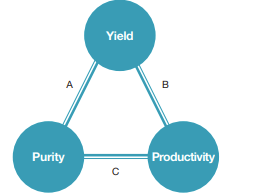
In preparative chromatography there are three key parameters: productivity, yield, and purity. How you balance these will dictate how you approach your scale-up from analytical to preparative HPLC. This is Part 2 of this technical tip. Please click here to review Part 1.
Part 2: How Much Can You Load?
Column loadability is a critical issue for preparative chromatographers because it directly influences the method's throughput. There is no simple answer to this apparently easy question - however, there are several ways to measure column loadability. The unique experimental way to determine sorbent loadability is to run a loading study under optimized analytical conditions (found through analytical method development), then increase the sample load stepwise, take fractions across the peak area of interest, and finally analyze the purity of the collected fractions.
Example A is a typical analytical method chromatogram. You can increase the sample load until you reach the example shown in B (touching bands). Further than this you begin to compromise on compound purity or yield, as shown in C (overlapping bands).
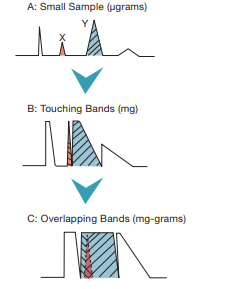
For those who would like to calculate the theoretical loadability, there is a simple loading rule of thumb. For a properly optimized reversed phase-HPLC process, the minimal specific loadability should be 1%. This is expressed as g of crude per 100 g of stationary phase. It has been found that normal-phase methods exhibit higher loadabilities compared to reversed-phase methods. Such results do not offer a hard rule for loadability because the key parameters of chromatographic separations (productivity, yield, and purity) are interdependent and cannot all be maximized simultaneously. The true loadability of a stationary phase is therefore a balance between these three parameters. It is therefore important to define the purification goals first, and then complete the analysis at several loading and fraction collection conditions to find optimal conditions to achieve the purification goal.
We hope you enjoyed this technical tip. Stay tuned for our next tip to improve your LC analysis skills!

Prep HPLC Process Development, Scale-up and Handling of Preparative Columns


Phenomenex is a technology leader committed to developing novel analytical chemistry solutions that solve the separation and purification challenges of researchers worldwide.
CONNECT WITH US


