
Sample Preparation Technical Tip
Level: Intermediate
What is the Matrix Effect?
The combined effect on signal response of all components of the sample, other than the analyte itself, is called the “matrix effect”. Sample matrix components that co-elute with the analytes of interest could cause the analytes’ signals to be enhanced or suppressed, compared with those measured with a standard solution of analytes (so, in the absence of matrix). This discrepancy could bring significant issues in accuracy, when not assessed and/or adjusted for.
To determine matrix effect, one can do a simple experiment by comparing the extracted analyte response to the non-extracted analyte response.

The most frequent approach to omit undesirable matrix effects is removing the matrix through sample preparation techniques (see Figure 1). These approaches can be as simple as sample filtration, protein precipitation and liquid-liquid extraction, or more sophisticated such as solid phase extraction and immunoaffinity capture. Matrix effects can in some cases be reduced or eliminated through LC method development, by using gradients or alternative column selectivities. However, sample preparation is often preferred because it helps to extend the LC column's lifetime.
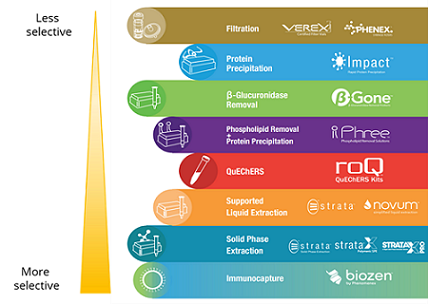
Figure 1: Common sample preparation approaches listed in order of lower to higher selectivity.
A common example of the matrix effect is the signal suppression observed when analyzing clinical samples, such as plasma or serum, with mass spectrometry detectors. In general, these samples undergo protein precipitation as the simplest clean up approach prior to analysis, which helps reduce possible protein build up on the LC column but does not remove other contaminants. Matrix components, especially phospholipids, may have an overall negative impact on LC analyses, and could even degrade system components over time.
In Figure 2 we compare the interfering signal coming from phospholipids in: (A) a serum sample that has undergone protein precipitation only and (B) a sample that has been further cleaned up using solid phase extraction with Strata™-X PRO.
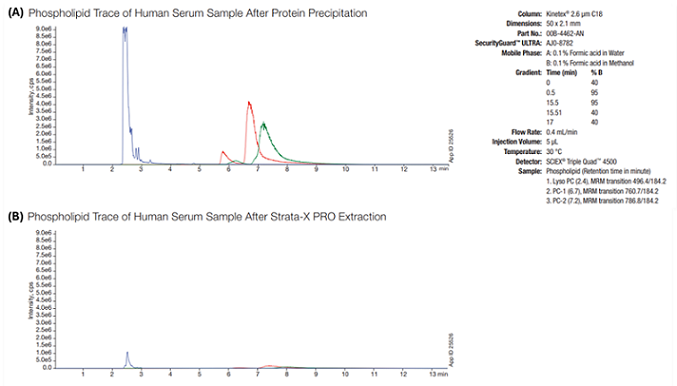
Figure 2: Phospholipid traces obtained from human serum samples after protein precipitation only (A) and after Strata-X-PRO extraction (B). MRM transitions targeted phosphatidylcholine, as this is the most abundant phospholipid in mammalian cellular membranes.
After Strata-X PRO clean up, we observed a ten-fold reduction of the interfering signal from phospholipids. This polymeric sorbent was specifically designed for enhanced matrix removal, and as demonstrated above, can remove phospholipids and harmful particulates from the sample, improving analyte recoveries as well as reproducibility.
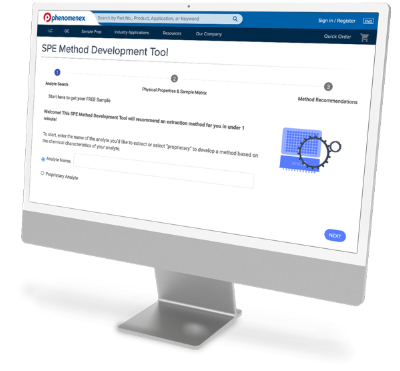
We hope this tip was useful! Check out our tool and products highlighted below.
See you next month for another tip!
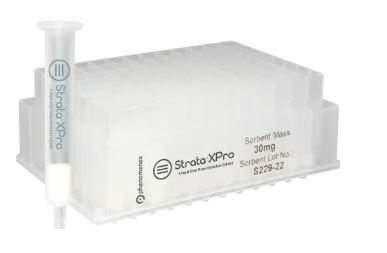
Strata-X PRO SPE Products
SPE Method Development Tool

Trademarks
Kinetex, Phenex, Impact, Phree, roQ, Novum, Biozen, β-Gone, and Strata are trademarks of Phenomenex.

Phenomenex is a technology leader committed to developing novel analytical chemistry solutions that solve the separation and purification challenges of researchers worldwide.
CONNECT WITH US


