
GC Technical Tip
Level: Intermediate
The Impact of Split Ratio on GC Chromatography Performance
The use of split/splitless injector ports on GC instruments provides the user with a large amount of flexibility for the introduction of samples to GC capillary columns. Many samples have analytes at concentrations which would saturate the limited capacity of a capillary GC column. The ability to split the sample without the need for dilution can be beneficial in many cases. When analysing samples with analytes at low concentration, reducing the split ratio and allowing more of the sample to enter the column can be desirable. However this approach can have problematic consequences.
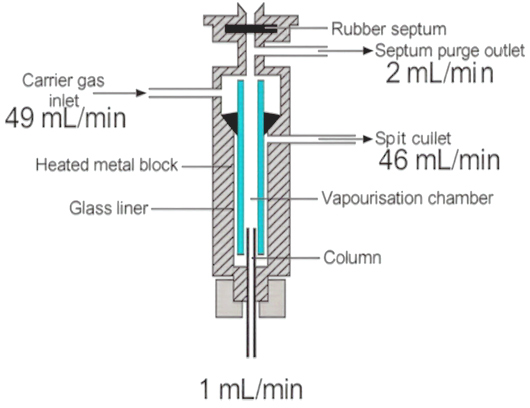
In order to understand why working at low split ratios can be problematic it is necessary to consider what happens inside the injection port.
The carrier gas enters on the left, a small amount (in this case 2 ml/min) exits through the septum purge outlet; this simply prevents any septum bleed, or contamination from samples deposited on the septum from bleeding through the injection port. The rest of the gas, 47 ml/min, sweeps through the injection port liner (shown in blue) before the majority of the gas exits through the split outlet. In this case the split ratio would be 46:1, with 46 parts of the sample exiting the system and 1 part going to the column. The key point here is the flow of gas through the liner. At 47 ml/min there is minimal sample dispersion, allowing for the rapid transit of analytes onto the head of the column in a narrow band.
Decreasing the split ratio does allow for more of the injected sample to enter the column. The overall flow through the injection port liner does decrease, which below a certain point will lead to the potential for peaks to tail with early eluting peaks being most greatly impacted. If the sample diluent (injection solvent) is low boiling, it is also possible that this peak will merge with early eluting compounds, causing problems with identification and quantitation. This is likely to take the form of the solvent peak tailing, which will then obscure peaks eluting immediately after it. Different column IDs are run at different flow rates, columns with a larger ID (0.53 mm) are less impacted than narrower (0.25 mm) when a low split ratio is employed. This all relates back to the linear velocity of the sample though the injection port liner. It is reasonable to estimate that we want a minimum of 10 ml/min flowing through the liner in order to keep sample dispersion low.
A 0.53 mm ID column operating at 2.5 ml/min will have a flow of 10 ml/min flowing through the liner with a split ratio of 1:3. A corresponding 0.25 mm ID column would have a split ratio of 1:9 with the same 10 ml/min flowing through the liner. The table below can be used as a guide for lowest split ratios based on column ID, although it is worth noting that these values are approximate and are impacted by choice of injection solvent and analyte volatility.
| Column ID: | Minimum advised split ratio |
| 0.25 | 1:15 - 1:20 |
| 0.32 | 1:10 - 1:12 |
| 0.53 | 1:3 - 1:5 |
Further information on the topic can be found by reading this article.
Webinar: Gas Chromatography Tips and Tricks
• Find new best practices for gas management, and learn how to keep your system clean
• Identify active sites and impurities within the column and system
• Learn how to properly cut your column and make the best connection
Zebron PLUS GC Inlet Liners
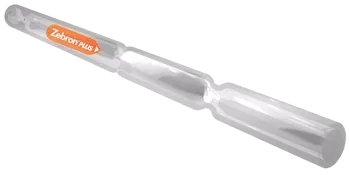
Optimized for trace and active compound analysis, Zebron PLUS GC liners undergo a unique chemical deactivation treatment resulting in a remarkably inert GC inlet liner.

Phenomenex, the P icon, and the Phenomenex product and service marks mentioned herein are trademarks or registered trademarks of Phenomenex, Inc. in the United States and/or other countries. All other trademarks are the property of their respective owners. One or more authors are affiliated with Phenomenex, Inc. FOR RESEARCH USE ONLY. Not for use in clinical diagnostic procedures. © 2026 Phenomenex, Inc. All rights reserved.

Phenomenex is a technology leader committed to developing novel analytical chemistry solutions that solve the separation and purification challenges of researchers worldwide.
CONNECT WITH US


