
GC Technical Tip
Level: Advanced
What You Need to Know About Electron Capture Detectors
There are various ways to categorize gas chromatographic detectors. The main classifications include:
• Detectors sensitive to concentration vs mass flow rate sensitive detectors
• Selective vs universal (non-selective) detectors
• Non-destructive vs destructive detectors
A concentration-sensitive detector is one in which the peak response depends on the absolute analyte concentration. At constant concentration, the response is constant regardless of change in flow rate of the carrier gas. If the flow rate changed, there will be no effect on the peak height of the analytes. On the other hand, a mass flow rate sensitive detector is one in which the peak response changes with the flow rate of the carrier gas. In other words, if the carrier gas flow rate is decreased, there will be a proportional decrease in peak height.
Universal detectors can see a wider variety of compounds, whilst a selective detector is very specific to certain chemical elements/groups. Non-destructive detectors maintain the same structure of the analytes as they had whilst passing through the column, while destructive detectors break down the actual molecule to produce signals. In GC analysis there is not much significance if the detector is destructive or non-destructive as there is no preparative work involved.
Electron capture detectors (ECD) are mass flow dependent detectors selective to electronegative elements and they are also non-destructive. ECD is actually the go-to and most sensitive detector for the analysis of electronegative compounds. Carrier gas is ionized by an electron source such as 3H or 63Ni. A low energy stream of electrons produce a steady current that is magnified and measured. The current decreases when an electron-capturing compound enters the detector. Loss of electrons by the electronegative compound is measured as signal.
ECD can detect from the picogram to nanogram level of concentration. As ECD is selective for electronegative compounds, it is the go-to detector for halogenated compounds, nitrogen, oxygen, and carbonyl group containing compounds.
The following are points to remember about ECD:
• The ECD detector has a radioactive element in it. So maintenance of the detector should be performed only by qualified professionals with appropriate radioactive shielding. Hardware disposal is strictly regulated by local legistlation.
• The ECD is compatible with ultra-high pure nitrogen and helium as the carrier gas.
• Since the detector is a mass flow rate detector, there is a proportional impact on peak area and peak height with change in flow rate. So the method cannot be developed under constant pressure or ramped flow mode for quantitative analysis. In other words, the method should be run under constant flow mode for quantitative analysis.
• Nitrogen or argon-methane mixture can be used as the makeup gases. The makeup gas flow and composition should be optimized for higher sensitivity and maintained constantly between consecutive runs to obtain reproducible quantitative results.
• The detector should operate at the operation temperature mentioned in the detector’s user manual. Usually, the upper limits are 350-400 °C, based on the manufacturer and model. Most ECDs are equipped with higher temperature limits and shut down if the temperature limit is exceeded.
• The carrier gas used for analysis should be free of oxygen, moisture and halocarbons, to extend the detector lifetime and to avoid baseline problems.
ECDs can be baked out at higher temperatures to clean them. However, the bakeout temperature should not exceed the maximum limit mentioned in the detector’s user guide. Since ECD contains a radioactive beta particle source, no attempt should be made to clean the detector mechanically.
We hope you found this tip helpful—stay tuned for next month’s technical insights!
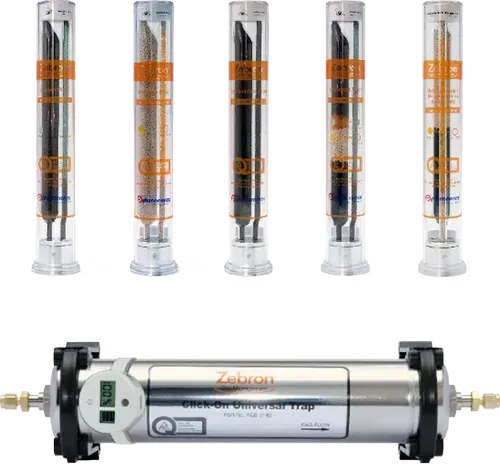
Zebron Filters and Traps
The high adsorption capacity of Zebron gas management filters removes contaminants from mobile phase gases which reduces potential column bleed, increases the lifetime of your column, and protects sensitive GC detectors from damage.
GC Troubleshooting Quick Reference Guide
The complete guide to GC troubleshooting with hints, tips, and tricks for chromatographic remedies.

Phenomenex, the P icon, and the Phenomenex product and service marks mentioned herein are trademarks or registered trademarks of Phenomenex, Inc. in the United States and/or other countries. All other trademarks are the property of their respective owners. One or more authors are affiliated with Phenomenex, Inc. FOR RESEARCH USE ONLY. Not for use in clinical diagnostic procedures. © 2026 Phenomenex, Inc. All rights reserved.

Phenomenex is a technology leader committed to developing novel analytical chemistry solutions that solve the separation and purification challenges of researchers worldwide.
CONNECT WITH US


