
GC Technical Tip
Level: Advanced
Constant Pressure or Constant Flow?
Why your carrier-gas mode changes early vs late peaks—and how to pick the right one.
If you’ve ever wondered whether to run constant pressure (CP) or constant flow (CF) on your GC, you’re not alone. Both move carrier gas through the column, but they behave differently as the oven heats — and that changes how early and late peaks look.
As temperature rises, the carrier gas in the column expands and gets more viscous. Forward flow naturally wants to slow down as the run progresses—an effect you’ll feel more on narrow‑ID columns. Figure 1 shows how flow falls during a temperature ramp when pressure is held constant.
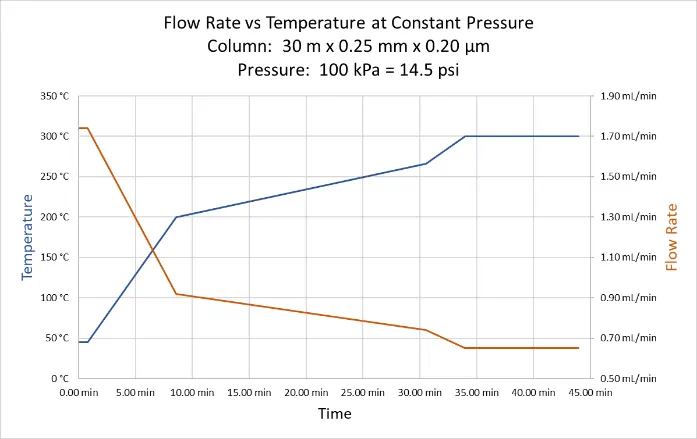
Fig 1: At constant pressure, carrier‑gas flow decreases as oven temperature rises; the effect is stronger on narrower ID columns.
Here’s a quick example using a PAH mix (EPA 610) on a 0.25 mm ID column. We compared two runs: CP at 100 kPa (≈14.5 psi) and CF at 1.03 mL/min (≈35 cm/s). Early analytes eluted faster under CP (initial flow is higher), while late analytes eluted faster under CF (pressure ramps to maintain the target flow). Figure 2 shows the chromatogram overlay—two critical pairs around 23.5 and 30.5 minutes stayed resolved once we optimized the flow/velocity where those pairs elute.
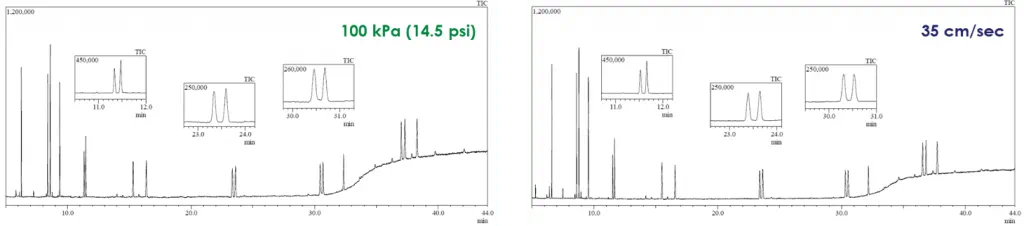
Fig 2: PAH method: CP vs CF. Early analytes are faster under CP; late analytes are faster under CF when flow is held constant.
Method details for the example are summarized in Table 1. Use these as a starting point and adjust around the elution window of your own critical pair(s).
| Column | |
| Dimensions | 30 metre x 0.25 mm x 0.20 µm |
| Injection. | Split 10:1 @ 300 °C, 1 µL |
| Carrier Gas | Helium (flow specified in chromatogram) |
| Oven | Initial 45 °C, hold for 0.8 min Ramp to 200 °C @ 20 °C/min Ramp to 266 °C @ 3 °C/min Ramp to 300 °C @ 10 °C/min, hold 10 min |
| Detector | MS @ 300 °C (transfer line and ion source) |
| Sample | EPA 610 (5 – 10 ppm) in toluene |
Table 1. Method parameters used for the PAH example
How do you choose in the real world? If your instrument doesn’t support constant flow, constant pressure is fine — just make sure forward flow is still healthy at the end of the ramp. If late peaks are dragging or broad under constant pressure, try constant flow (or constant linear velocity). Very narrow columns often benefit from constant flow as the oven heats up, but watch instrument pressure limits near the end of the run. Above all, set and verify your flow at the time your critical pair elutes, not just at the beginning.
Do you have any questions about constant pressure vs. constant flow—or anything GC? Our technical consultants are happy to help. Start a live chat or reach out for support online.
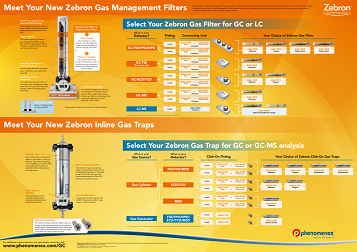
GC Gas Management Selection Poster
This poster allows GC scientists and chromatographers to choose the correct GC Zebron phase based on polarity, applications and other criteria. In addition, a gas management selection tool helps select the appropriate filter or trap for GC instruments

GC Column Care and Installation Guide
Ensure your Zebron GC column is properly installed and maintained with this handy guide to GC column care.

Phenomenex, the P icon, and the Phenomenex product and service marks mentioned herein are trademarks or registered trademarks of Phenomenex, Inc. in the United States and/or other countries. All other trademarks are the property of their respective owners. One or more authors are affiliated with Phenomenex, Inc. FOR RESEARCH USE ONLY. Not for use in clinical diagnostic procedures. © 2026 Phenomenex, Inc. All rights reserved.

Phenomenex is a technology leader committed to developing novel analytical chemistry solutions that solve the separation and purification challenges of researchers worldwide.
CONNECT WITH US


