The HPLC Method - Why This is Important
The following method-related technique suggested improvements will enhance performance for all column separations. When using core-shell columns, the following things may significantly improve the performance of your method.
HPLC methods should first work towards focusing the sample on the head of the column, and then minimizing sample dispersion through the column. When you minimize band broadening through reducing sample dispersion you improve sensitivity and resolution of your peak.
Incorporating simple injector programming in the method can minimize extra-column volume to improve peak shape and efficiency, especially for fast LC separations.
Trouble: All Peaks are Broad
1. Check Sample Volume: Errors in sample loading may negate the performance gain the core-shell particle can achieve. If you inject the sample in the same organic composition as the mobile phase under isocratic conditions, the initial bandwidth on column will be directly proportional to the injection volume. As such, a large volume sample is injected as a wide band on the column and gives low peak efficiency.
Solution: To reduce the efficiency loss of large volume injections, it is possible to pre-concentrate the sample on the head of the column by using a weaker diluent than the mobile phase. You can also reduce your sample injection volume. When high efficiency columns are used often lower sample amounts are needed to get good signal response.
2. Check Sample Diluent: If the organic strength of the diluent is greater than the HPLC mobile phase, then the sample will load as a diffuse band at the head of the HPLC column. This may occur in either isocratic or gradient methods and can negate much of the performance advantages that the column delivers.
- Gradient methods where the sample is injected in a stronger injection solvent than the mobile phase the compound exhibits surfing effects, which will cause peaks to broaden and split.
- Isocratic methods where the diluent is stronger than the mobile phase will result in excessive sample dispersion.
Solution: Inject a weak solvent. It is best to use a diluent either weaker or equal to the organic strength of the mobile phase so that the sample focuses on the head of the column, resulting in sharper peaks (i.e., higher efficiency).
Goal: Further shorten the runtime and peak capacities in gradient methods
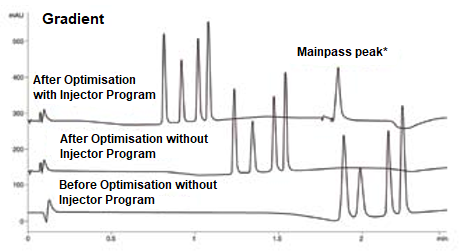
Check Injector Program: Extra-column volume before the column will cause dispersion of the sample on the way to the column; the injector loop is a major source of extra-column volume.
Solution: It is possible to bypass the loop with an injector program during the analysis method (after the sample has left the injector loop). Table 1 and Figure 1 show an example where the injection loop is bypassed after injection to reduce system dwell volume.
| Steps | Commands | Comments |
|---|---|---|
| 1 | DRAW | Draw volume of sample (injection volume) from vial |
| 2 | INJECT | Introduce sample into flow path |
| 3 | WAIT | Flush sample loop after injection (wait time = 6x (injection volume + 5 μL) / flow rate) |
| 4 | VALVE bypass | Direct flow from pump to column, bypassing injection valve to exclude delay volume (~200 – 500 μL from auto-injector path) |
| 5 | WAIT 1.5 min. | The period of VALVE bypass time (Wait time = Run time - 1 min) |
| 6 | VALVE mainpass | Switch valve from bypass to injection position |